
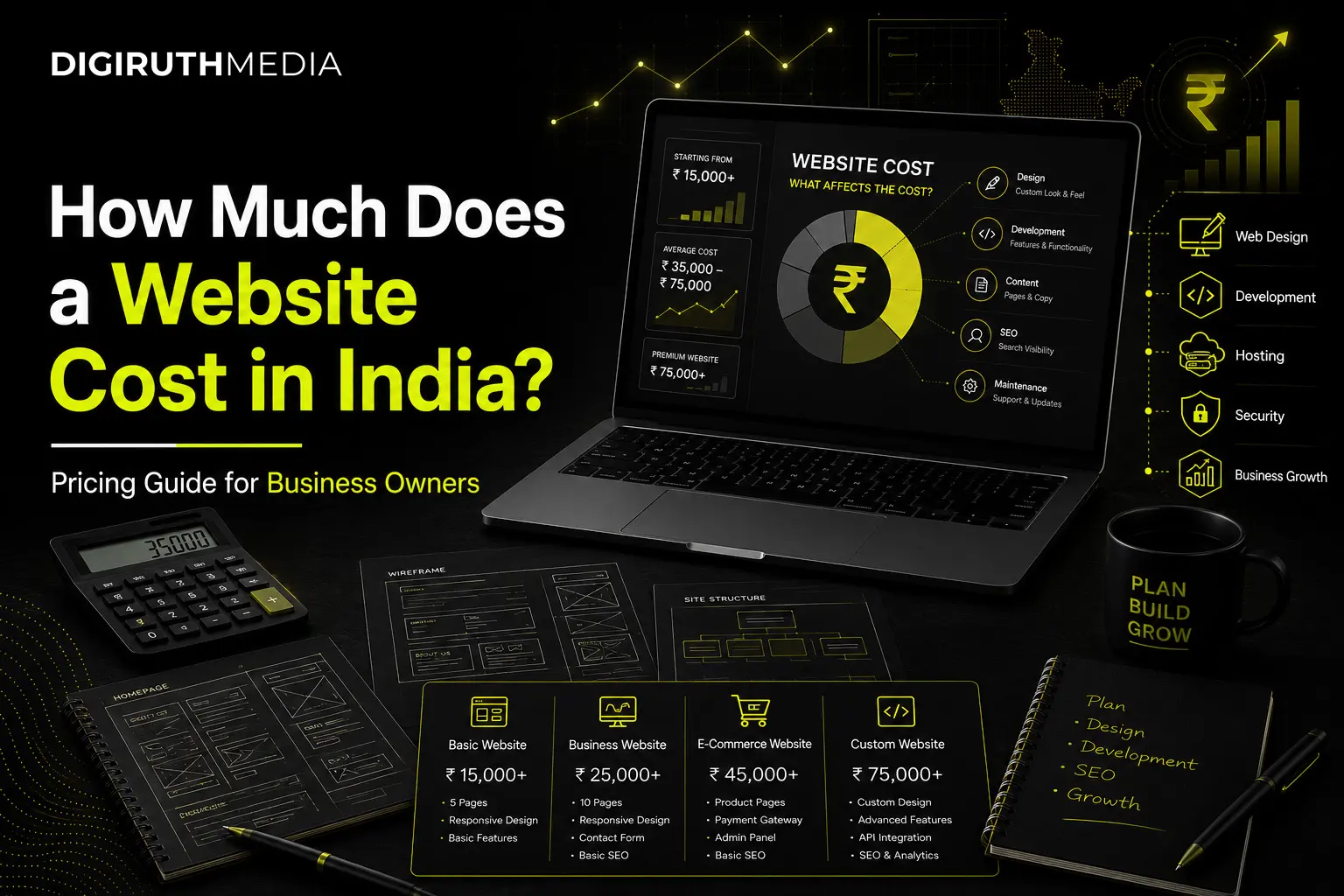
How much a website costs in India is one of the first questions almost every business asks before even contacting a web design agency.
The first place many business owners look for the answer today is ChatGPT, Gemini, or another AI assistant. Most of them will give you a price range somewhere between ₹5,000 and ₹5,00,000. While technically correct, that answer doesn’t really help you make a business decision. While technically correct, that answer doesn’t really help you make a business decision.
A price range this wide creates more confusion than clarity.
It’s not because AI is wrong. The reality is that website pricing genuinely depends on several factors, including the type of website you need, the features and functionality, the platform it’s built on, the level of customization, and the experience of the agency or developer you choose.
Before we talk about pricing, let’s change the way you think about a website.
A Website is not an expense—it’s a digital asset. Think of it like building a factory for your business. A factory manufactures products. Your website manufactures opportunities. It works 24/7 to build trust, generate enquiries, capture leads, and help your business grow—even while you’re sleeping.
Unfortunately, this is where many businesses make an expensive mistake. They focus only on getting the lowest quote instead of understanding the value they’re buying. While a cheaper website may reduce your initial investment, it often leads to slow loading speeds, security vulnerabilities, hidden maintenance costs, poor user experience, and eventually an expensive redesign.
That’s exactly why we created this guide.
Instead of giving you another vague price range, we’ll break down the cost of every major component involved in a professional website. By the end of this guide, you’ll understand what influences website pricing, how to evaluate a proposal from an agency or freelancer, and how to estimate the right budget for your own website with confidence.
Let’s first look at the key factors that affect the cost of a website.
What Affects the Cost of a Website?
There is really not a fixed price for websites because every business has different goals and requirements. Think about designing your office. Before an interior designer gives you a quotation, they first need to understand your requirements. They ask about the office size, the layout, your design preferences, the materials, furniture, lighting, and your budget. Only then can they estimate the actual cost.
Website development works exactly the same way.
To understand it more clearly, let say two business both need a website for their business. One business only needs a professional website to showcase its services. While the other required a customized website that can create customer accounts, do online payments, book appointments, can integrated with CRMs. See, here the first business only need a web design, a simple template may be customized for him, which reduces the cost. But for other business, everything needs to be designed and developed according to the client’s specific requirements, without any templates. So, the requirement are very different in both project. The following factors have the biggest impact on the cost of a website.
Not sure which type of website is actually right for your business? Explore the 10 signs that indicate it’s time to invest in a professional website before deciding on features or pricing.
1. Type of Website
The biggest factor affecting website cost is the type of website you need. A simple business website generally costs much less than an e-commerce store or a custom web application because the complexity and development effort are significantly different.
2. Number of Pages
A five-page website requires far less planning, design, content organization, and testing than a website with 50 or 100 pages. More pages usually mean more design work and more development time.
3. Design & Customization
A template-based website is quicker and more affordable than a fully custom-designed website. Businesses that require unique layouts, animations, branding, or interactive elements should expect a higher investment.
Many businesses use the terms website design and website development interchangeably, but they’re not exactly the same. Website design focuses on how your website looks and how users interact with it, while website development is about building the functionality behind it.
A simple business website may require minimal development, whereas features like customer logins, online payments, dashboards, or booking systems involve significantly more development effort—which naturally increases the project cost.
4. Features & Functionality
Every additional feature increases the overall project scope. Examples include:
- Contact forms
- Appointment booking
- Online payments
- Customer login
- Product filters
- Wishlist
- Courier tracking
- CRM integrations
- Chat systems
- Multi-language support
Many businesses make the mistake of asking for every possible feature simply because they’ve seen it on another website. In reality, every additional feature increases development time, future maintenance, and cost. The best website is not the one with the most features—it’s the one with the right features aligning with your business goals.
5. Content Preparation
If you already have professionally written content, images, and branding assets, the project becomes faster. If the agency has to write content, source images, or create graphics, the overall cost increases.
6. SEO Requirements
Some businesses only need a website, while others want their website to rank on Google. Proper keyword research, technical SEO, schema implementation, optimized page structure, and content strategy require additional work and expertise.
7. Maintenance & Support
Launching a website is only the beginning. Regular updates, backups, security monitoring, bug fixes, and performance improvements ensure the website remains secure and performs well over time. Some agencies include maintenance, while others charge separately.
8. Experience of the Agency
Finally, the expertise of the developer or agency also plays a significant role. An experienced team often charges more because they bring proven processes, better design quality, cleaner development practices, stronger security, and long-term reliability.
The more unique your business requirements are, the more time, expertise, and development effort the project requires—and that directly influences the overall cost.
Now let’s look at the different types of websites and how they affect the overall cost.
Still wondering how to compare different agencies? Explore our guide on choosing the right web design agency in India before making your final decision.
Different Types of Websites
Before estimating the cost of your website, it’s important to understand the different types of websites available. Once you know which category best suits your business, estimating the cost becomes much easier.
After understanding this you can easily select the best website for your business. Understanding the right type of website instantly helps you cut unnecessary costs that often arise from choosing the wrong type of website.
For example, a restaurant may need online table reservations, while a clothing brand requires an e-commerce store. Similarly, a manufacturing company may only need a professional business website to showcase its products and generate enquiries.
Below are the most common types of websites.
1. Business Website
A business website is designed to establish your online presence, build credibility, and generate enquiries. It usually includes pages such as Home, About Us, Services, Portfolio, Blog, and Contact.
Best suited for:
- Service-based businesses
- Consultants
- Agencies
- Manufacturers
- Educational institutes
- Healthcare providers
- Local businesses
2. E-Commerce Website
An e-commerce website allows customers to browse products, add them to a shopping cart, make online payments, and place orders directly through the website.
Unlike a standard business website, an e-commerce website requires product management, inventory handling, payment gateways, shipping integration, order management, customer accounts, and many other advanced features.
Many businesses end up paying for features they’ll never use, while others try to save money by choosing a website that doesn’t support their business goals. Choosing the right type of website isn’t just about reducing cost—it’s about making the right investment.
Best suited for:
- Fashion brands
- Retail stores
- Electronics
- Home décor
- Food products
- D2C brands
3. Portfolio Website
A portfolio website focuses on showcasing work, projects, achievements, and professional experience. Its primary goal is to demonstrate expertise and build credibility.
Best suited for:
- Architects
- Interior designers
- Photographers
- Graphic designers
- Artists
- Freelancers
4. Booking & Appointment Website
These websites allow customers to schedule appointments or book services online. They often include appointment calendars, automated confirmations, reminders, and payment integration.
Best suited for:
- Doctors
- Clinics
- Salons
- Coaches
- Lawyers
- Fitness trainers
5. Custom Web Application
Some businesses require features that cannot be achieved with a standard business website or an e-commerce platform. These projects involve custom design and development based on unique business processes.
Examples include:
- Customer dashboards
- Courier tracking systems
- CRM integrations
- Inventory management
- Learning Management Systems (LMS)
- Membership portals
- Employee portals
Best suited for:
Businesses with unique operational requirements that require custom software solutions.
Choosing the right type of website is the first step towards investing your budget wisely. Building an e-commerce website when your business only needs a business website can lead to unnecessary costs. On the other hand, choosing a simple website when your business requires advanced functionality may result in expensive upgrades later.
At Digiruth, we recommend choosing a website that aligns with your business goals rather than simply choosing the cheapest option. A well-planned website becomes a long-term business asset that grows with your company, while the wrong choice often leads to unnecessary upgrades and additional costs later.
Now let’s see how much it typically costs to build a website in India.
How much does it cost to build a website in India? (2026)
Now that you understand the factors affecting website pricing, let’s answer the question you’ve been waiting for—how much does a website cost in India?
As discussed earlier, the final cost always depends on your project requirements. However, the table below provides a realistic industry-standard price range for different types of websites in India (2026).
| Website Type | Estimated Cost |
| One Page / Landing Page Pricing | ₹5,000 – ₹12,000 |
| Small Business Website Pricing (5–10 Pages) | ₹10,000 – ₹30,000 |
| Professional Corporate Website Pricing | ₹25,000 – ₹75,000 |
| E-Commerce Website Pricing | ₹25,000 – ₹1,50,000+ |
| Custom Web Application Pricing | ₹75,000 – ₹5,00,000+ |
Please note that these are estimated standard price ranges. The final project cost totally depends on the scope of work, features, level of customization, integrations, and the overall complexity of the project. Simply put—the more features, customization, and functionality you require, the higher the investment.
While comparing different quotations for the same website project, remember that a lower price doesn’t always mean a better deal, and a higher price doesn’t necessarily mean you’re being overcharged. Every agency or freelancer prices a project based on their understanding of the scope, experience, development process, and the value they deliver.
Before making a decision, ask what’s included in the quoted price and whether there are any additional or ongoing costs. Many businesses focus only on the initial cost and later discover hidden costs they didn’t plan for. Let’s take a look at some of them.
Hidden Costs of a Website
This is where many businesses get shocked after approving a website proposal. In most cases, the proposal only includes the website design cost and it’s development cost. However, designing and developing a website is only one part of the overall investment. There are several additional costs that come with owning and maintaining a website. Some agencies discuss these costs upfront, while others only mention them when the project is ready to launch.
Think of it like purchasing plant and machinery for your business. The quoted price is only part of the investment. You may also have to pay for shipping, customs duty, insurance, installation, and other associated costs. A business website works in a very similar way
Below are some of the common web design cost in India that business owners often overlook while planning their website.
1. Domain Name
Web hosting is the land on which your digital factory is built. Every website file, image, video, and database is stored here. Better hosting generally provides faster loading speeds, stronger security, higher uptime, and a better experience for your visitors.
2. Web Hosting
Your website consists of file, media (Pictures, Icons, Fonts, Videos) etc. so they need a place where the can be stored and hosted on the servers. Choosing the right server provided improved speed, security, uptime, and overall performance. This is the place where your factory build upon.
3. SSL Certificate
An SSL certificate acts like the security system of your website. It protects data transferred between your visitors and your website while displaying the HTTPS padlock in the browser, helping build trust.
4. Website Maintenance
Websites require regular updates, themes, plugins, backups, and security patches. Ignoring maintenance can lead to security vulnerabilities and website downtime.
5. Premium Plugins & Licenses
Some advanced features require premium plugins or software licenses. These may include page builders, booking systems, SEO tools, payment integrations, security plugins, or marketing automation tools.
6. Content Updates
As your business grows, your website will also need updates. Adding new services, portfolio projects, blog articles, images, team members, or pricing information often requires ongoing support.
7. SEO & Digital Marketing
Launching a website doesn’t automatically bring visitors. If your goal is to generate enquiries through Google, you’ll likely need ongoing SEO, content marketing, or paid advertising to attract qualified traffic.
8. Future Improvements
Businesses evolve over time. You may later require additional features such as customer dashboards, payment gateways, CRM integrations, WhatsApp automation, or entirely new service pages.
The good news is that most of these costs are predictable when planned properly, you just need to be aware and proactive while finalizing your proposal.
Before starting any website project, ask your agency exactly what is included in the proposal and what may involve additional charges in the future. A transparent quotation today helps avoid unexpected expenses tomorrow.
💡 Pro Tip:
Before signing any proposal, ask these four questions:
- Is domain included?
- Is hosting included?
- How long is free maintenance?
Which premium plugins require annual renewal?
Now that you know what a website costs and the hidden costs that may come later, the next step is choosing the right web design agency.
How to Choose the Right Web Design Agency
Again, the lowest proposal should not be the only reason for choosing a web design agency for your project.
A professional website is something you’ll rely on for years. It represents your brand, generates enquiries, builds trust, and often becomes the first impression potential customers have of your business.
Before finalizing an agency, ask yourself these important questions.
1. Do They Understand Your Business?
A good agency doesn’t immediately start talking about colours, layouts, or animations. Instead, they first try to understand your business, your customers, your goals, and the problems you’re trying to solve.
2. Review Their Work & Relevant Experience
Experience is valuable, but it shouldn’t be the only deciding factor. Ask to see their previous work, portfolio, or similar projects. More importantly, look at the quality of their work, their attention to detail, and whether they understand businesses like yours. Sometimes, hiring a newer agency with a good portfolio or strong design capabilities can also get you a discount on the project cost.
Every agency starts somewhere. A smaller agency with a thoughtful approach and direct founder involvement can often provide more attention and flexibility than a larger agency handling hundreds of projects at once.
3. Is Everything Clearly Mentioned in the Proposal?
A professional proposal should clearly mention:
- Scope of work
- Number of pages
- Features included
- Timeline
- Payment terms
- Revisions
- Maintenance
- Additional charges (if any)
Don’t forget to clarify any hidden or recurring costs before signing the proposal. A clear proposal helps avoid misunderstandings later.
4. Who Will Actually Build the Website?
Many agencies outsource their work to freelancers or third-party developers. There’s nothing inherently wrong with outsourcing, but you should know who will be responsible for your project and who you’ll communicate with throughout the development process.
If the agency outsources development, ask about their communication and escalation process. Knowing who is responsible for resolving issues can save you a lot of frustration later.
5. What Happens After Launch?
Launching a website isn’t the end of the journey. Ask whether the agency provides maintenance, technical support, updates, training, or future improvements if your business grows.
6. Do They Focus on Value Instead of Just Price?
The cheapest proposal isn’t always the best proposal.
Instead of asking:
“Who is charging less?”
Ask:
“Who is providing more value for my investment?”
A professionally planned website can support your business for years, while a poorly built website often requires expensive fixes and redesigns.
At Digiruth, we believe every business is different. Instead of offering one-size-fits-all solutions, we take time to understand your business goals and recommend a website that aligns with your requirements—not just your budget.
The right website isn’t the one that costs the least. It’s the one that creates the greatest value for your business over the long term.
And be careful before selecting a proposal based only on price. Instead, compare the value you’re receiving for the investment you’re making. Remember, a website isn’t an expense—it’s a business asset. Unlike many business investments, your website can generate enquiries, build trust, and help grow your business 24/7 without needing an office or a sales team. That’s exactly why choosing the right website matters more than choosing the cheapest one.
Common Mistakes Businesses Make When Hiring a Web Design Agency
One of the biggest mistakes businesses make is treating a website as something they simply need for their visiting card or online presence. In reality, a website is a long-term business asset. To reduce the initial cost, many businesses compromise on planning, design, or development, only to face expensive upgrades, poor performance, and lost business opportunities later.
Here are some of the most common mistakes to avoid.
1. Choosing the Cheapest Proposal
The lowest quotation isn’t always the best value. A cheaper website may compromise on quality, security, scalability, or long-term support, often resulting in expensive fixes or a complete redesign later. Don’t negotiate on getting the thing cheapest, just remember every business has a cheap solution. Always compare the value with the cost.
2. Not Defining Business Goals
Many businesses begin a website project without clearly defining what they want the website to achieve. Before discussing design, features, or pricing, identify your primary goal—whether it’s generating leads, selling products, booking appointments, showcasing your portfolio, or building brand credibility. A website built without a clear objective often looks good but fails to deliver meaningful business results.
Not sure whether your current website needs improvements or a complete rebuild? Explore whether you should redesign your website or build a new one before investing further.
3. Not Confirming Mobile Responsiveness Before Finalizing the Project
Mobile responsiveness has become a standard expectation for modern websites, but don’t assume it’s automatically included in every proposal. Before finalizing the project, confirm that the website will be fully responsive, tested across different screen sizes, and clearly mentioned as included or excluded in the quoted price. A poor mobile experience can reduce enquiries, lower conversions, and negatively impact your search visibility.
4. Focusing Only on Design Instead of Business Results
Many businesses focus only on how the website will look and forget to discuss how it will perform. Before finalizing your web design agency, make sure the project also covers website speed, user experience, SEO fundamentals, and conversion-focused design. A great website isn’t just visually appealing—it should also help your business attract visitors, build trust, and generate enquiries.
5. Not Asking About Website Maintenance & Support
Many businesses focus only on the website delivery and forget to ask what happens after the project is completed. Before hiring a web design agency, ask whether website maintenance, security updates, backups, bug fixes, and technical support are included or available as a separate service. Knowing this in advance helps you avoid unexpected costs and ensures your website remains secure and performs well over time.
6. Paying for Features You Don’t Need
Every additional feature increases development time, complexity, maintenance, and cost. Before approving extra functionality, ask yourself whether it genuinely supports your business goals or simply looks impressive. A good web design agency should recommend features that create value for your business—not features that only increase the project cost.
The best websites aren’t necessarily the most expensive ones—they’re the ones that are carefully planned around the business they are built for.
Frequently Asked Questions (FAQs)
The cost of a website in India generally ranges between ₹5,000 and ₹5,00,000+, depending on the type of website, features, customization, integrations, and overall project complexity.
Because every website has different requirements. A simple business website requires significantly less effort than an e-commerce website or a custom web application with advanced functionality.
A professionally designed small business website generally costs between ₹5,000 and ₹30,000, depending on the number of pages, design quality, and required features.
An e-commerce website usually starts from ₹25,000 and can exceed ₹1,50,000 depending on the number of products, payment gateways, shipping integrations, custom features, and overall complexity.
Some common hidden costs include:
1. Domain renewal
2. Web hosting
3. Website maintenance
4. Premium plugin licenses
5. Content updates
6. SEO services
7. Future feature additions
Always ask your agency what is included before approving the proposal.
A standard business website usually takes 2–6 weeks, while larger e-commerce or custom development projects may require several months depending on the project scope.
Want a detailed breakdown of every stage involved? Explore how long it actually takes to build a professional business website.
A standard business website usually takes 2–6 weeks, while larger e-commerce or custom development projects may require several months depending on the project scope.
Yes. A website without SEO may struggle to attract visitors through search engines. If your goal is to generate enquiries or sales online, SEO becomes an essential long-term investment.
It depends on your business goals. A service business may only need a professional business website, while product-based businesses usually require an e-commerce website. Businesses with unique workflows may need custom web applications.
Absolutely. A professionally planned website can grow along with your business by adding new pages, features, integrations, or functionality whenever required.
If you’re unsure, don’t worry. Every business has different goals, customers, and requirements. Instead of choosing a website based on price alone, discuss your business objectives with your web design agency and let them recommend a solution that aligns with your business.
Conclusion
By now, you probably have a much clearer understanding of how much a website costs in India and, more importantly, why there isn’t a fixed price.
A website isn’t priced based on the number of pages alone. Its cost depends on your business goals, required features, level of customization, long-term vision, and the value you expect it to create.
Instead of asking:
“How can I get a cheapest website?”
Start asking:
“ Which web design agency can build a website that actually helps my business grow?”
That one question alone can completely change the way you look at your website investment.
Remember, your website isn’t just another business expense. It’s your digital business asset. It works 24 hours a day, builds trust, generates enquiries, supports your marketing efforts, and continues representing your business even when you’re not working.
If you’re planning to build a new website or redesign your existing one, take your time, define your business goals, compare proposals based on value rather than price, and choose a web design partner who understands your business—not just your requirements.
If you’re still researching before making a decision, explore the 10 reasons businesses choose to work with a professional web design agency instead of handling everything themselves.